
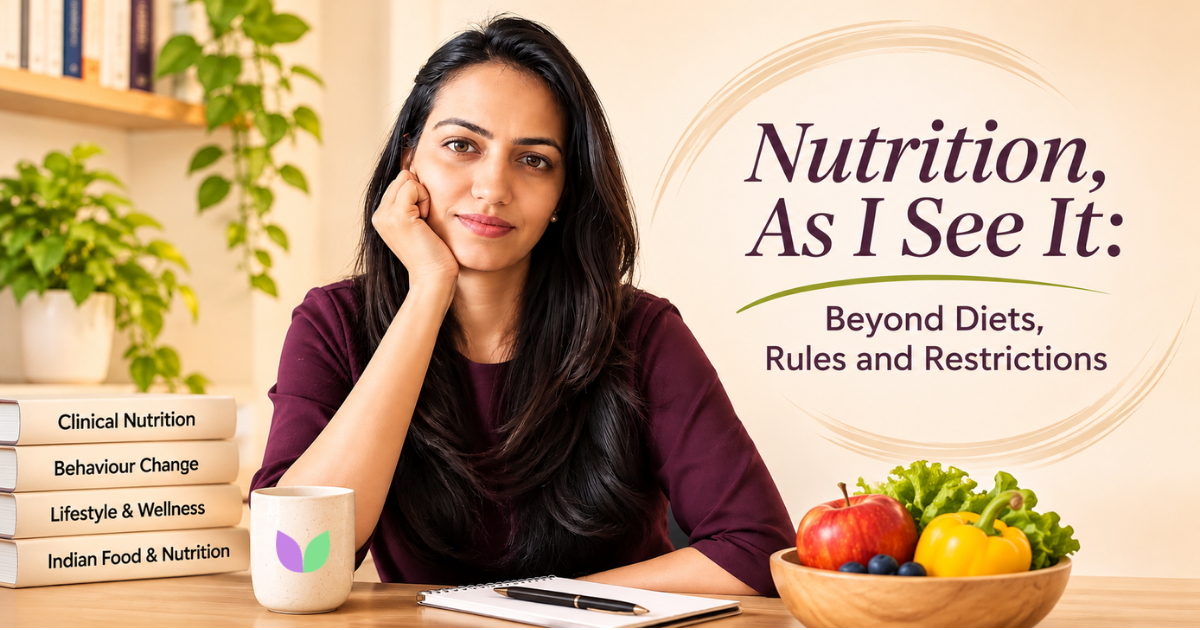
I learned the science of nutrition through textbooks. But I learned how to make nutrition work through people.
When I look back at my journey in nutrition, I realise that some of my most important lessons did not come from a classroom, a textbook or a research paper. They came from the people I worked with.
I hold a Master’s degree in Food and Nutrition, and over the years, my understanding of clinical nutrition, healthy eating and personalized diet planning has evolved considerably.
During my academic years, we were trained to understand the science behind food, calculate nutritional requirements, assess dietary intake and prepare diet plans based on individual needs.
I remember working on case studies where every nutrient had to be accounted for. We calculated calories, proteins, fats, carbohydrates and even individual micronutrients. Every requirement had to be met.
If a particular case required 40 grams of dietary fibre, we had to find ways to achieve that number. Sometimes, our calculations would include ingredients or quantities that looked perfectly reasonable on paper but were hardly practical in someone’s everyday kitchen.
We understood the science. We knew the nutritional principles. We could prepare a diet that fulfilled the prescribed requirements.
But there was something we had not yet learned.
We had not fully understood the person who was expected to follow that diet.
My First Real Lessons About Nutrition Came From My Clients
When I began practising, I thought that if I understood the nutritional requirements and prepared the right diet, I had done my job.
But my early experiences taught me otherwise.
People would look at a diet plan and tell me, “Shivani, this is not possible. We have work, family, responsibilities and an entire life beyond food. We cannot spend the whole day thinking about what to eat.”
And they were right.
A diet could be nutritionally appropriate, but that did not automatically make it practical. A plan could look perfect on paper, but if it did not fit someone’s routine, preferences, family meals, work schedule or circumstances, it was unlikely to become a sustainable part of their life.
In those early years, I often felt that my clients were teaching me as much as I was guiding them.
They made me question my assumptions. They helped me see the gap between knowing what is nutritionally correct and understanding what is actually possible.
And that changed the way I looked at my profession.
Why Personalized Nutrition Matters
Over time, I had the opportunity to work with people from different parts of India and even outside the country.
I encountered very different food cultures, eating habits, family structures, cooking practices and lifestyles.
Some people ate three structured meals. Others had different meal timings altogether. Some cooked every day, while others depended on family members, shared kitchens or meals outside the home. Food choices were influenced by culture, geography, availability, preferences and family traditions.
I began to understand that we cannot simply take one dietary framework and apply it to everyone.
Even when two people have similar health concerns, their nutritional needs, food preferences and daily circumstances may be very different.
A diet that is appropriate for one person may not be practical or suitable for another.
This made me realise that personalized nutrition is not simply about changing quantities or substituting one food for another. It is about understanding the context in which a person eats and lives.
Why a Perfect Diet Plan Does Not Always Work
As my experience grew, I became better at understanding food habits and preparing plans that were more practical and personalized.
Yet I noticed another challenge.
Even when we created a diet plan that considered someone’s health requirements, food preferences and lifestyle, following it consistently was not always easy.
Why?
Because knowing what to do and actually doing it are two very different things.
People have habits that have developed over many years. They have emotional relationships with food, family expectations, work pressures, stress, changing routines and days when health is simply not their priority.
Sometimes, the difficulty was not knowing what to eat. It was finding the motivation, confidence and consistency to make a change.
That was when I started looking beyond food.
I began appreciating how much our mindset, emotional state, everyday habits and behaviour influence our ability to make lasting changes.
I realised that giving someone the right nutritional information is important, but helping them translate that information into everyday decisions is equally important.
A diet chart cannot address every barrier. Sometimes, people need support in understanding their habits, recognising their patterns and gradually changing the behaviours that keep bringing them back to where they started.
Nutrition Is About Understanding the Person, Not Just Their Reports
My approach to nutrition has evolved considerably over the years.
Today, when someone comes to me, I don’t want to understand only their symptoms, diagnosis or blood reports.
I want to understand the person behind them.
What does a typical day look like? What do they eat, and why? What are their sleep patterns like? How do they manage stress? What are their food preferences? What has their previous experience with dieting been? What changes have they tried, and what made those changes difficult to sustain?
These conversations take time.
Understanding someone beyond their symptoms and reports is not a one-day exercise. It develops through conversations, observation, follow-ups and learning how a person responds to different changes.
This is also why I believe meaningful nutrition support is a process, not a one-time prescription.
When someone works with me over three, six or nine months, the approach evolves as we understand more about their health, their responses, their challenges and what is realistically working for them.
The objective is not simply to hand over a diet plan. It is to help them build an approach to health that they can understand, follow and eventually feel confident managing themselves.
Sustainable Nutrition Should Fit Into Real Life
I believe that healthy eating should support your life, not take it over.
Nutrition is still about science. It is about nutritional requirements, food composition, clinical evidence, medical history and understanding how the body functions.
But I have learned that science alone is not enough if we cannot translate it into something meaningful for the person sitting in front of us.
A sustainable approach to nutrition should consider everyday routines, family meals, cultural preferences, work schedules and individual health needs.
It should not make people anxious about every meal. It should not make them feel that their familiar foods are suddenly wrong or that they have failed because they could not follow a perfect diet.
And particularly in the Indian context, I believe we should recognise the value of our everyday food traditions. Balanced nutrition does not necessarily require abandoning familiar meals or adopting complicated eating patterns. It requires understanding how to make those meals work for individual nutritional needs.
What I Believe Nutrition Should Be
After years of working in this field, my perspective is simple.
Nutrition should be evidence-based, but also practical.
It should be personalized, but not unnecessarily complicated.
It should respect our food traditions while remaining open to scientific understanding.
It should address individual health needs without creating unnecessary fear around food.
And above all, it should help people understand their bodies, make informed choices and build healthy habits that they can sustain.
I still believe in carefully planned nutrition. But today, I spend just as much time understanding the person for whom that plan is being created.
Because ultimately, the best nutrition plan is not necessarily the one that looks perfect on paper.
It is the one that makes nutritional sense, respects the individual and has a realistic place in their life.
Perhaps that is the biggest lesson my journey has taught me:
I started my career learning how to calculate a diet. Over the years, I have learned that good nutrition is about understanding people.
And that is how I see nutrition today.
Beyond diets. Beyond rules. Beyond restrictions. Back to understanding the person.
Shivani Jain is a Clinical Dietitian and Nutrition & Wellness Expert with a Master’s degree in Food and Nutrition and over 15 years of experience. Her approach focuses on personalized, evidence-based nutrition built around Indian food, individual health needs and real-life routines.
Frequently Asked Questions
1. What is personalized nutrition?
Personalized nutrition considers an individual’s health history, nutritional requirements, food preferences, lifestyle, eating habits and personal circumstances to develop an approach that is appropriate and practical for them.
2. Why doesn’t the same diet work for everyone?
People differ in their health conditions, nutritional needs, digestion, food preferences, activity levels, routines and lifestyles. A dietary approach that works for one person may not be appropriate or sustainable for another.
3. Why is a nutritionally balanced diet not always easy to follow?
A diet may meet nutritional requirements but still be difficult to follow because of work schedules, family responsibilities, food availability, established habits, emotional factors and personal preferences. Practicality and consistency matter alongside nutritional adequacy.
4. Why should nutrition consider mindset and lifestyle?
Eating habits are influenced by more than nutritional knowledge. Stress, emotions, routines, motivation and behaviour can affect how consistently someone follows dietary recommendations. Considering these factors can help make nutrition changes more realistic and sustainable.
5. Can Indian food be part of a healthy diet?
Absolutely. Familiar Indian foods such as dal, vegetables, legumes, grains, curd and regional preparations can contribute to balanced eating. The right choices, portions and combinations depend on individual nutritional needs and health conditions.
6. Why is nutrition counselling an ongoing process?
Understanding a person’s health, habits and challenges takes time. Follow-ups help assess responses, identify barriers, refine recommendations and support sustainable changes rather than relying on a one-time diet prescription.